Using Quadratic Expressions in Vertex Form to Solve Problems
Student Summary
Any quadratic function has either a maximum or a minimum value. We can tell whether a quadratic function has a maximum or a minimum by observing the vertex of its graph.
Here are graphs representing functions f and g, defined by f(x)=-(x+5)2+4 and g(x)=x2+6x−1.
- The vertex of the graph of f is (-5,4), and the graph is a parabola that opens downward.
- No other points on the graph of f (no matter how much we zoom out) are higher than (-5,4), so we can say that f has a maximum of 4, and that this occurs when x=-5.
- The vertex of the graph of g is at (-3,-10), and the graph is a parabola that opens upward.
- No other points on the graph (no matter how much we zoom out) are lower than (-3,-10), so we can say that g has a minimum of -10, and that this occurs when x=-3.
We know that a quadratic expression in vertex form can reveal the vertex of the graph, so we don’t actually have to graph the expression. But how do we know, without graphing, if the vertex corresponds to a maximum or a minimum value of a function?
The vertex form can give us that information as well!
To see if (-3,-10) is a minimum or maximum of g, we can rewrite x2+6x−1 in vertex form, which is (x+3)2−10. Let’s look at the squared term in (x+3)2−10.
- When x=-3, (x+3) is 0, so (x+3)2 is also 0.
- When x is not -3, the expression (x+3) is a nonzero number, and (x+3)2 is positive.
- Because a squared number cannot have a value less than 0, (x+3)2 has the least value when x=-3.
To see if (-5,4) is a minimum or maximum of f, let’s look at the squared term in -(x+5)2+4.
- When x=-5, (x+5) is 0, so (x+5)2 is also 0.
- When x is not -5, the expression (x+5) is nonzero, so (x+5)2 is positive. The expression -(x+5)2 has a coefficient of -1, however. Multiplying (x+5)2 (which is positive when x=-5) by a negative number results in a negative number.
- Because a negative number is always less than 0, the value of -(x+5)2+4 will always be less when x=-5 than when x=-5. This means x=-5 gives the greatest value of f.
Visual / Anchor Chart

Standards
F-IF.2
Use function notation, evaluate functions for inputs in their domains, and interpret statements that use function notation in terms of a context.
F-IF.C
No additional information available.
A-SSE.3.b
Choose and produce an equivalent form of an expression to reveal and explain properties of the quantity represented by the expression.
F-IF.92 questions
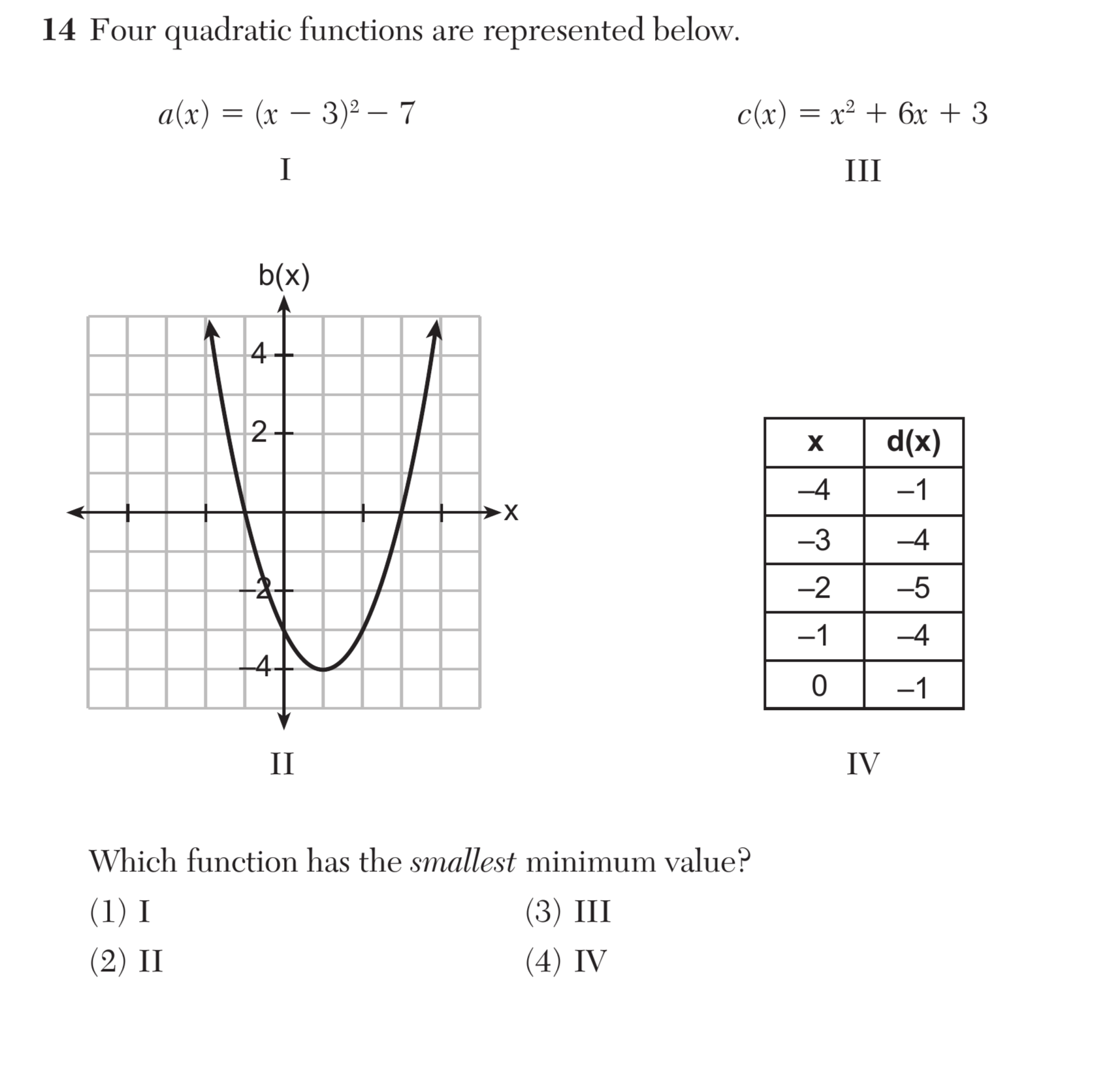
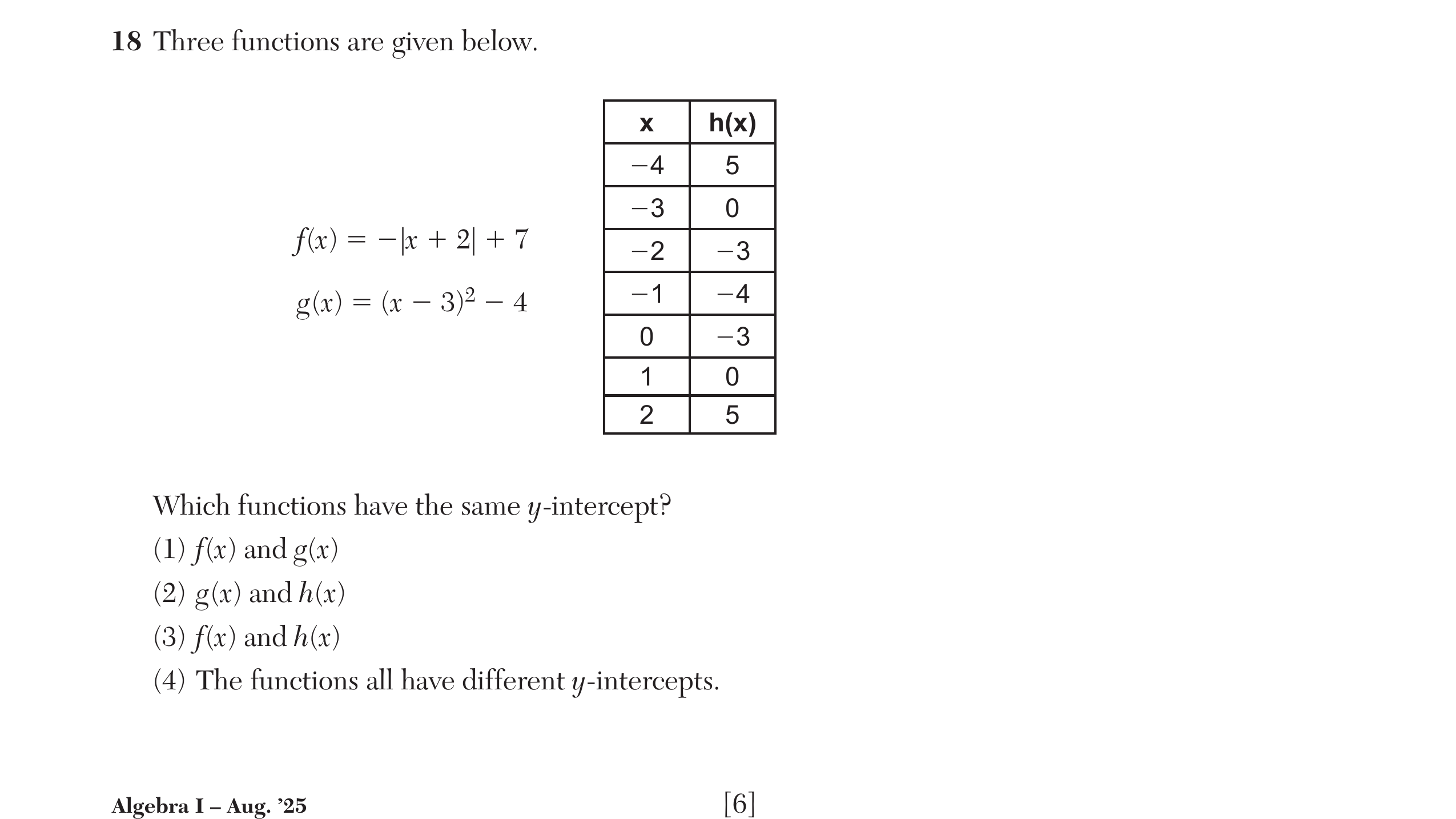
Compare properties of two functions each represented in a different way (algebraically, graphically, numerically in tables, or by verbal descriptions).
A-SSE.3.b
Choose and produce an equivalent form of an expression to reveal and explain properties of the quantity represented by the expression.